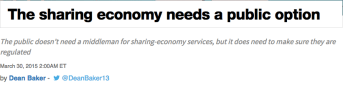
Just came across Dean Baker’s opinion piece on Aljazeera America from yesterday in which he advocates for a publicly-run version of the “sharing economy.” In Baker’s own words:
In addition to a level-the-playing-field approach, we can also treat the sharing- economy companies to some new competition: a public option. The idea is that governments can set up public sites that would provide the same services as the sharing economy companies. The difference would be that the public sites would cut out the middleman. They would be set up to benefit customers and service providers, with the government charging only the fees necessary to cover costs.
While this sounds on the surface like something I’d be in favor of, having worked at one of these tech companies, I know first-hand how unworkable it would be to have government-run sharing apps. Full-stack product development, setting up initial networks, targeted marketing, and real-time empathic customer service are just not in the government wheelhouse. Governments regulate — that’s their wheelhouse. And that’s what they should be doing with a long-view on the sharing/on-demand economy.
Right now, many local governments across the globe are in panic mode — creating regulations in reaction to new technologies that have real-world impacts (Uber and AirBnB are the obvious players here, but there are so many others: TaskRabbit, Handy, Car2Go, MiniBar, PostMates, and on and on). Workers, customers, and even former employees are filing lawsuits against on-demand companies left and right. I see this as part of the natural process of establishing equilibrium. But it doesn’t have to be this difficult — or litigious.
The sharing economy is here to stay, and it will only continue to grow. There is so much potential for positive change from these emerging technologies. Bike-sharing is one excellent example, especially when implemented in an intelligent way. But regulators need to educate themselves on what’s out there and what the implications of each application might be, not only for health, safety, and labor, but also for other as-yet unknown impacts. Governments need to get one step ahead instead of ten steps behind.
They also need to stop clinging to the status quo, protecting entrenched industries just because they’re, well, entrenched. It’s time to weigh the benefits and drawbacks of the innovative versus the status quo, and figure out sensible and sensitive regulatory cocktails that benefit and protect the most citizens. This, of course, is no small feat, but I believe our governments are up to the task. They can do this better than they would ever be able to manage running a technology company, that’s for sure.
It’s time for governments to become innovators, not of technology, but of regulation.
Read Dean Baker’s piece here:
Aljazeera America

 MEL PLAUT
You must be logged in to post a comment.